Thursday, November 25, 2010

Fountain of Youth

It's been a while since I returned from Atlanta, and I've been hunkering down for winter, stacking firewood, getting logs and basically trying to stay awake past 8pm! Above is a shot from the class at Highland. It was a lot of fun, we had students from the south, midwest and even all the way from Israel.


Here is one of the students kids taking the sample chair for a test spin!

The other day a friend of mine, who also happens to by my physician (his brother is my vet, small town!), came by to make a couple of hickory firewood carriers. He's been suffering carting wood inside in his arms and we've both been trying to clear a day in our schedules to get him properly set.

His work has been stressing him out lately, he's basically handling the work of two doctors everyday and he'll be on call for the next two months without a break. This man needed to beat on a log.


He took to the sledge hammer with such vigor that I just stepped back and decided to let the two of them work it out. During the days discussions, he told me that the worst part of his day is that he has to multitask constantly. When he said this, it dawned on me that when folks come to my shop to make a chair, they get to do just one thing at a time. It's a sad statement that most of us literally have to run away from home and be doled out tasks one at a time to stop this scattered way of being


As the day progressed, I was surprised to look over at him and see that his face, that had been a bit worn looking, seemed fuller and brighter. I swear I could see the teenager inside coming to the surface.
Below is one of the carriers in it's form. It's a way more complex form than is necessary, but it makes a lovely, uniform bend.


I've been noticing a lot of this kind of stress, unnamed and omnipresent in my friends lately, and I've decided that my means of fixing the world is going to start by doing one thing at time, or at least remembering that if I'm stressed, at least I know one of the culprits!

So kick back, focus on eating some turkey and talking to your family (remember, no politics) and pet your goats,


Happy Thanksgiving!

Wednesday, October 20, 2010

Splitting Boards (Not Hairs)

In the never ending search for methods to make my work more efficient and enjoyable, I've started having my hard maple sawn into planks. 

If the main reason to split the parts from the log is maintaining the straight fiber line and turning green wood, then I've lost nothing in this process and gained quite a bit. The problems that arise when dealing with the logs are spoilage (I like splitting only what I need, instead of a whole log at once, but in summer, this is a recipe for spalting), waste through splitting,  and the troubles associated with moving a whole log.


By having my logs (which are chosen for their straightness) sawn by a conscientious sawyer, I get the best of both worlds, plus, if the boards sit for a while in the stacks, they dry, not rot!

As you see above, the first split is down the pith. Because the 2 inch chunks of maple that I split off don't deflect much, I can generally just make my way across the board splitting off the blanks. If the sawn line deviates from the fiber line a bit, I can subtly adjust the way that I mount it on the lathe to 
correct the problem.


I've found that this works well even with air dried maple, and for my oak turnings, I've been splitting oak boards. The main benefit that I've found with the oak, is that the parts don't check while drying, which is a problem that I kept having when splitting and turning green oak. I'm not going to lie to you, turning dry wood ain't nearly the joy of green wood, but as with most things, you will draw your own lines in the sand!

Yes, I actually built a new brake! Here is the layout for the hole locations in the side. The numbers locate the holes from the left and bottom edges.


I did choose to include a leverage arm. I put notches in it to hold the straps in place. Knowing where the stresses most affected my old brake, I reinforced this one with plywood scraps from the start.


On the home front, here is Seth (remember him building my countertop) and his lovely bride Johanna at their wedding in Salem. They stopped by for a couple of days on their way to their new home in Asheville.


And for my goat fans (this is you Tee), here is the Chair Notes covergirl with her favorite little fellow. Boy has he grown!


He's a bit dopey but she loves him (yes, I know what this implies).
All of our others are healthy, happy and living as a herd. I'm heading to Atlanta tomorrow to demonstrate and teach at Highland Woodworking, I hope to see you there!

Friday, October 8, 2010

Proof of Concept

Every year, my brake gets a little uglier. Usually it breaks through abuse, the freeze, thaw cycle and the life outdoors, but I scab on some old scrap of wood and keep it going, always promising myself that soon I'll build another. Yesterday I had an idea that might just spur me on to really do it.


After giving my talk about splitting, you know, that one about how when both sides of a split piece deflect the same amount, the split always runs straight, I had an idea. Whenever I come up with something that I haven't seen or tried, I try to find the shortest distance to the "Proof of Concept". I did it with my caliper (the first one used an old plane blade and some rubberbands) and I do it with my chairs.

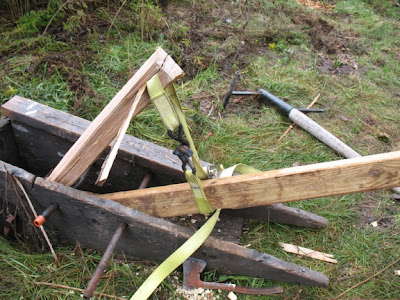
So while looking at the brake, it dawned on me how easy it would be to hook up a lever to increase the leverage on the larger side to get the equal deflection while splitting. My student this week was game so we took a few minutes and rigged up this fine looking contraption.


Here is Peter (there are a strange number of Peters in woodworking) applying the necessary pressure and splitting off a small crest for his comb back. It worked like a charm, too well actually, as he was able to make the split run into the larger piece!
Most of the time when splitting, we strive to split equal sized parts because even deflection is relatively easily achieved, but necessity means that we must often split off a third of a chunk, and this is where the extra leverage comes in handy.


The biggest problem with the "Proof of Concept" moment, is that I am often so enthralled by the crude simplicity of the thing, that I'll use it that way for years!


Here is Dan finishing up his triple back a few weeks ago. I really like this chair and hope to own one myself someday!